A content plan rarely stalls because you've run out of ideas. It stalls because every month, you start from a blank page.
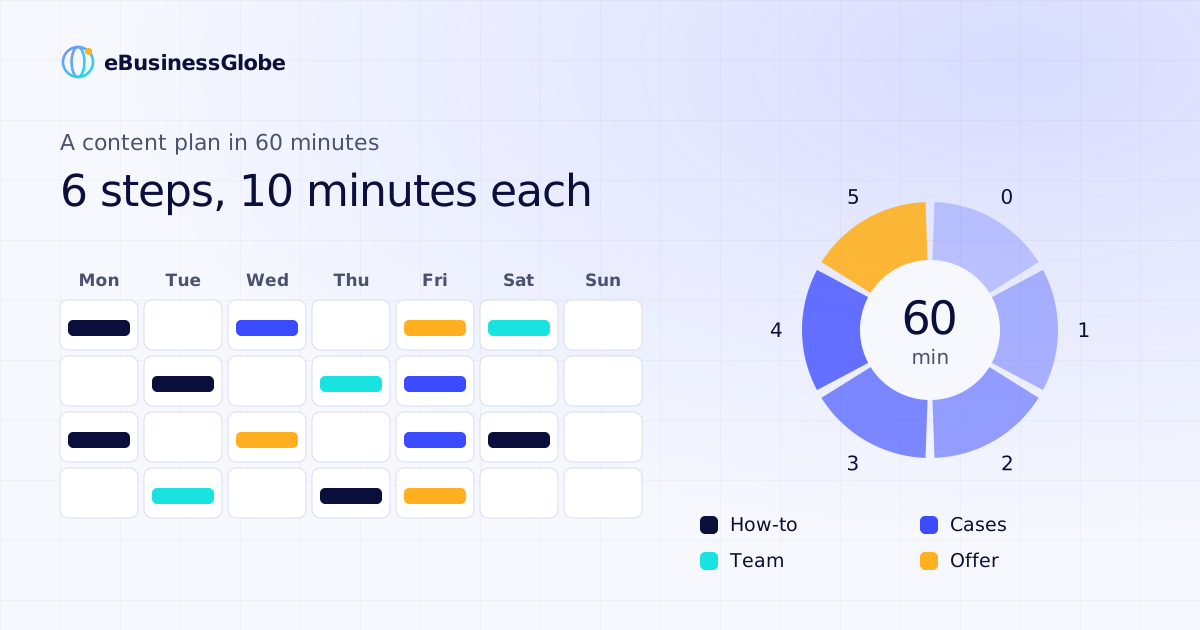
Below is a six-step workflow, ten minutes per step: from a "business brief" to a checked posting calendar, with prompts you can paste straight into ChatGPT or Claude. At the end, you'll find a sample plan for a hypothetical coffee shop, and the mistakes that make AI churn out clichés.
What you'll have in an hour
You'll walk away with a monthly table: date, content pillar, topic, format, goal and call to action. Plus a bank of 40 spare topics and a business brief you can reuse next month.
What you'll need:
- ChatGPT or Claude. The free version works, but paid plans have higher limits on message length and number of messages.
- One hour without switching to anything else.
- Knowledge of your own business: who your customers are, what they buy, what holds them back.
The six steps:
- Step 0. Business brief (10 min): the context without which AI writes "for everyone and no one."
- Step 1. Content pillars (10 min): five pillars, each with a share of the plan and a job to do.
- Step 2. Topic bank (10 min): 40 specific topics, each tied to a customer question.
- Step 3. Monthly calendar (10 min): a table with dates, formats and goals.
- Step 4. Hooks and prep (10 min): opening lines for each post, and a list of what to shoot or gather.
- Step 5. Review (10 min): a plan with no repeats, no invented facts and no overload of sales posts.
An honest caveat: the first time, it will take closer to an hour and a half, because you're filling in the brief from scratch. From the second month on, the brief is ready and the hour becomes real.
Work in a single chat from the first step to the last: each prompt builds on the answers to the previous one.
Step 0. The business brief
AI knows exactly as much about your business as you've told it. Ask for a content plan without context, and you'll get "5 tips for choosing coffee" and "Happy holidays!" So the first ten minutes go not into a prompt but into filling in a template. Keep your answers short, in your own words.
BUSINESS BRIEF
1. What we sell: [products or services, average order value]
2. Who buys: [2–3 customer types, one line each]
3. Questions customers ask us: [5–7 real questions]
4. What holds them back from buying: [3–5 doubts or objections]
5. What sets us apart: [2–3 facts we can back up]
6. What we do NOT do or promise: [e.g., "we don't offer discounts"]
7. Brand voice: [3 adjectives, e.g., "calm, precise, witty"]
8. Platform, frequency and posting days: [e.g., Instagram, 3 posts a week, Mon/Wed/Fri]
9. Goal for the month: [leads, sales of a specific product, reach, trust]
10. This month's events: [holidays, promotions, launches — or "none"]
Save the brief as a separate file. If you use Projects in ChatGPT or Claude, upload it to the project so you don't have to paste it in every time.
Step 1. Content pillars
A content pillar is a recurring type of post with a clear job. Without pillars, your plan turns into a random set of topics. With them, readers recognize your content and know what to expect.
Our working baseline is five types of pillars. It isn't a law; it's a starting point that the AI will tailor to your business:
- Useful tips and myth-busting. Job: reach and saves. Typical share: 30–40%.
- Process and behind the scenes. Job: trust, by showing how you work. Typical share: 15–20%.
- People. Job: the human face of the business. Typical share: 10–15%.
- Answers to questions and objections. Job: removing doubts before purchase. Typical share: 15–20%.
- The offer. Job: leads and sales. Typical share: 10–15%.
Prompt 1: content pillars
You are a content strategist. Below is my business brief.

[paste the brief]

Task: propose 5 content pillars for [platform] for the month.
For each pillar, give:
1) a name of up to 4 words;
2) its job (e.g., reach, trust, handling objections, leads);
3) which customer question or doubt from the brief it addresses;
4) its share of the plan as a percentage (all shares must add up to 100%);
5) one example topic.

Rules:
- Don't suggest pillars that require data not included in the brief (case studies, testimonials, client numbers).
- If information is missing, first ask me up to 5 clarifying questions and wait for my answers. Otherwise, present your answer as a table.
Why the prompt is built this way. Tying pillars to the questions in the brief keeps the AI from drifting into generic topics. Banning pillars that need missing data protects you from invented case studies: without that rule, the model will happily suggest a "Client success stories" pillar you have nothing to fill with. And giving it permission to ask questions reduces the risk that it fills the gaps on its own.
Step 2. The topic bank
Now we turn pillars into specific topics. The key rule: a topic is a single idea, not an area. "Pricing" is an area. "Why we don't run discounts in December" is a topic.
Prompt 2: topic bank
Using the pillars from your last answer (with any changes I've asked for), propose 8 topics for each pillar, 40 in total.

Requirements for each topic:
- One specific idea, not an area: "Why we don't run discounts in December," not "Pricing."
- The topic answers a customer question or doubt from the brief.
- If a topic needs numbers, a case study, or a testimonial, tag it [needs data].
- Don't repeat the same idea in different words.

In the Tag column, mark with ★ the 10 topics closest to a purchase decision.

Number the topics. Format: a table with the columns "# | Pillar | Topic | Customer question | Tag".
Next comes five minutes of manual work. Cross out any topics you don't like or that don't sound like you. Keep topics tagged [needs data] only if you genuinely have the data. Then type the numbers of the topics you're keeping into the chat.
Step 3. The monthly calendar
Prompt 3: the calendar
Create a content plan for [month and year] for [platform]: [N] posts a week, on [days of the week].

Rules:
- Use only the topics I kept from the bank.
- Stick to the pillar shares, rounded to whole posts.
- Never schedule two posts from the same pillar back to back.
- Spread the ★ topics across the whole month rather than bunching them at the end.
- Take this month's events from the brief into account.
- Every week (Monday to Sunday) must include at least one post with a direct call to action: [DM us / book now / visit the website].
- Double-check that every date matches its day of the week.

Format: a table with the columns "Date | Day of week | Pillar | Topic | Format (post, carousel, video, story) | Goal | Call to action".
Check the dates against a calendar right away. Language models often get the days of the week wrong, especially where one month runs into the next.
Step 4. Hooks and the prep list
The first line decides whether anyone reads on. Ask for two options per post, and at the same time, for a list of what needs to be prepared in advance, so a missed shoot doesn't derail the plan.
Prompt 4: hooks and prep
For each row of the plan:
1) suggest 2 options for the opening line (the hook), up to 12 words each;
2) add a "What to prepare" column: photos, video, numbers, a quote from a team member.

Hook requirements:
- Specifics instead of generalities.
- A promise the post actually delivers on.
- No clickbait, no all-caps, and none of these words or phrases: "shocking," "secret," "100%."

Brand voice: [3 adjectives from the brief].
Here is a sample of my writing to match: [paste 3–5 sentences from one of your best-performing posts; no posts yet? write 3–5 sentences the way you'd talk to a customer].
A sample of your own writing matters more than any adjectives: it shows the model your voice far more precisely.
Step 5. The review
Ask the AI to critique its own plan. Models are good at finding mistakes when you explicitly cast them as a strict editor and give them criteria.
Prompt 5: the editor
Now act as a strict editor and review the plan against these criteria:
1) Are any topics or ideas repeated?
2) Are the pillar shares respected?
3) Are there topics with no link to the customer questions in the brief?
4) Are there promises, numbers, or facts that can't be backed up by the brief?
5) Is the plan overloaded with sales posts (the Offer pillar should stay around 10–15%)?
6) Is there a week without a direct call to action?
7) Do the dates match the days of the week?

For each criterion, say Pass or Fail. Then list the problems and suggest a fix for each one. Don't rewrite the whole plan.
Then spend two minutes checking it by hand. No prompt can replace this:
Example: a plan for a hypothetical coffee shop
This is a teaching example. The business is fictional; it contains no figures or case studies, only the logic of the plan.
The brief, in short. A coffee shop that roasts its own beans and sells drinks and beans to take home. Customers: local residents, people from nearby offices, and home brewers. Frequent questions: which coffee to choose for a Turkish cezve or a moka pot, how to store beans. Doubts: "It's more expensive than the supermarket," "I don't know anything about coffee varieties." Platform: Instagram, three posts a week, on Monday, Wednesday and Friday. December goal: sales of gift sets.
Pillars:
- Coffee Without Myths: reach and saves, 35%.
- How We Roast: trust, 20%.
- The People Behind the Counter: the human face of the business, 15%.
- You Asked: removing doubts, 15%.
- Offer of the Week: leads, 15%.
The first two and a half weeks of December 2026:
- Wed, Dec 2 · Coffee Without Myths. "Is Arabica always better than Robusta?" A myth, unpacked. Format: carousel. Goal: saves. CTA: save this cheat sheet.
- Fri, Dec 4 · Offer of the Week. A home-brewing gift set for the holidays: what's inside and who it suits. Format: photo post. Goal: leads. CTA: DM us to order.
- Mon, Dec 7 · How We Roast. A day in the life of our roaster: from a sack of green beans to a bag of coffee. Format: video under 60 seconds. Goal: trust. CTA: ask our roaster a question in the comments.
- Wed, Dec 9 · You Asked. Why our coffee costs more than the supermarket's. Format: post. Goal: remove a doubt. CTA: tell us which question to answer next.
- Fri, Dec 11 · Coffee Without Myths. How to store coffee beans at home: four rules. Format: carousel. Goal: saves. CTA: send this to someone who stocks up on coffee.
- Mon, Dec 14 · The People Behind the Counter. Our barista and their favorite brewing method. Format: video. Goal: trust. CTA: tell us how you brew yours.
- Wed, Dec 16 · You Asked. Which grind you need for a cezve, a moka pot or a filter. Format: carousel. Goal: saves. CTA: save this so you get it right at the store.
- Fri, Dec 18 · Offer of the Week. How to choose coffee as a gift when you don't know the person's taste. Format: post and story. Goal: leads. CTA: DM us for a gift set or a gift card.
Notice: no pillar appears twice in a row, sales posts go out no more than once a week, every post has a call to action, and the topics answer real questions from the brief.
The mistakes that make AI churn out clichés
- Asking for a plan without a brief. You get topics "for everyone" that would suit any coffee shop in the world. Fix: start with Step 0.
- Asking for 30 finished posts at once. You get uniform, average copy that's hard to edit. Fix: the plan first, then the posts, one topic at a time.
- Taking dates and facts on trust. Wrong days of the week, invented numbers. Fix: check against a calendar, and don't leave any fact without a source.
- Letting AI invent case studies and testimonials. It undermines trust and can lead to complaints. Fix: an explicit ban in the prompt, plus the [needs data] tag.
- Posting nothing but sales content. Readers get tired and unfollow. Fix: keep the "Offer" pillar at 10–15% of the plan.
- Not looking at the results. Every month, the plan is built blind. Fix: review the results once a month with the prompt below.
Prompt 6: monthly review (for next month's plan)
Here are last month's post results: [table with the columns "Topic | Pillar | Format | Reach | Saves | Comments | Leads"].

1) Name the 3 topics or formats that performed better than average, and explain what they have in common.
2) Name the 3 weakest ones and suggest likely reasons.
3) Suggest how to adjust the pillar shares for next month.

Base your answer only on the numbers in the table. If there isn't enough data to draw a conclusion on any point, say so for that point instead of forcing a ranking.
That last line matters: without it, the model will confidently find patterns even in eight posts.
Cheat sheet
- Fill in the business brief once; after that, just keep it updated.
- Pillars: five of them, each with a share and a job.
- Topic bank: 40 specific ideas; cross out the ones that don't fit.
- Calendar: dates, formats, goals, calls to action.
- Hooks and a prep list.
- Review: the AI editor, plus your own two minutes.
- Once a month, review the results.
Bookmark this article: next month, you'll only need Prompts 3–6, what's left of your topic bank and the latest events in your brief.
If you'd rather not do this yourself every month
The workflow above works, but it takes discipline: every month you have to sit down, remember the prompts and go through the steps. If you'd rather have a system run this work, there's a ready-made set of twelve roles: "AI Marketing Department in a Box."
What's inside:
- 12 digital employees with ready-made instructions: a producer-strategist, a researcher, a scriptwriter, a viral editor, a designer, a Telegram channel host, an Instagram manager, an analyst and others;
- a business knowledge-base template, an expanded version of the brief from this article;
- a "1 video → up to 20 posts" pipeline and a weekly work cycle;
- 30 commands and templates: a brief, a script, a post, a content plan, a weekly report;
- 12 months of updates.
It takes an evening to set up in Claude or ChatGPT. No coding required: you just copy and paste, following the instructions. You'll need a Claude Pro or ChatGPT Plus subscription, about $20 a month.
- Box — $119. The full set, with access immediately after payment and a 7-day refund.
- Box + Group Launch — $349. Everything in the Box, plus a two-hour live online workshop and 30 days of support.
- Done for You — $1,490. The eBusinessGlobe team sets up the system for your brand within 10 business days, builds your content plan for the month and trains a member of your team.
What we don't promise: virality, or sales growth "several times over." What we do promise: a system, volume and hours saved.
You can start for free: send the keyword РЕДАКТОР (Russian for "editor"; copy and paste it as is) to our Telegram bot, @ebusinessglobe_bot. You'll get one of the twelve employees, the Viral Editor, and can test the approach on your own posts. You can choose a plan there, too.
Ready-made solution: AI Marketing Department in a Box
Sources
This is a hands-on guide: it cites no external statistics or studies. Product prices and contents are from the eBusinessGlobe catalog as of Oct 31, 2026; the coffee shop in the example is fictional, and the example dates were checked against the calendar.