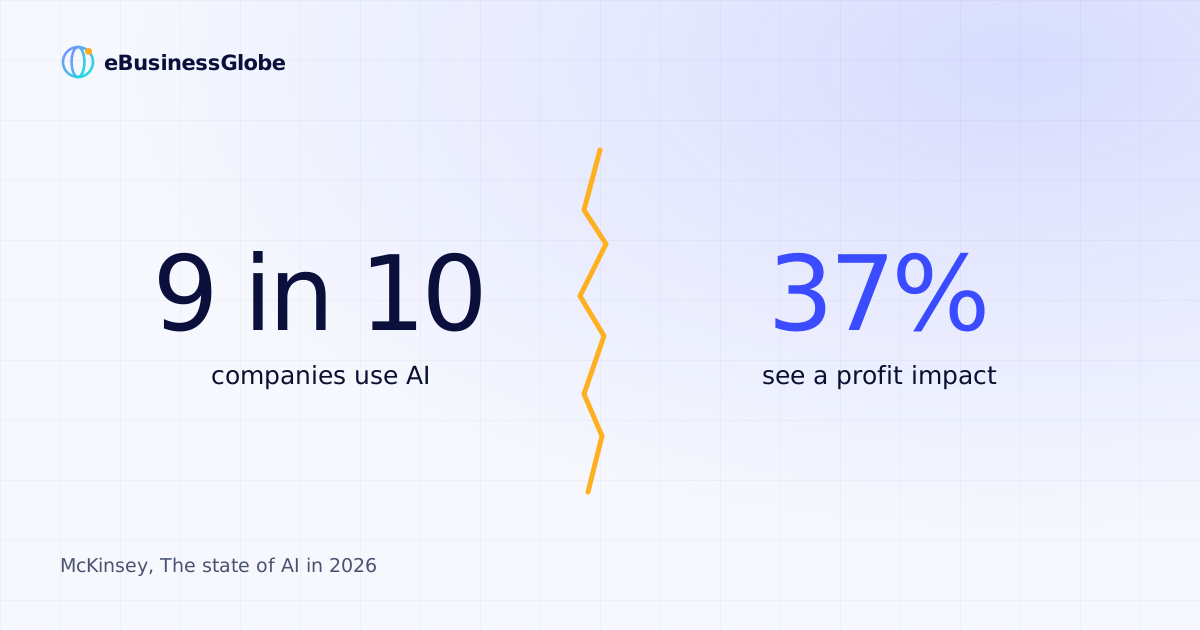
Nearly nine in ten companies now use AI, yet only 37% see any contribution to operating profit, and that share hasn't grown in a year. The gap between "we use it" and "we make money with it" is exactly where the people selling thin air set up shop.
Let's take the market's three loudest promises, check them against the research from 2025 and 2026, and put together a checklist for spotting an honest vendor.
A market built on promises
Open any feed: "AI will replace your sales team." "The algorithm will bring you customers on its own." "Master AI in three days and make your first million." It's sold with confidence, revenue screenshots and countdown timers on the discount.
My position is simple, and not everyone in this industry will sign up to it: AI makes money in a different place from where it's sold most loudly. Not in "replacing a department," and not in "customers on autopilot," but in the unglamorous redesign of specific processes, where the result can be calculated before you start and verified afterwards. A vendor who can't name the metric before the work begins isn't selling AI. They're selling hope.
This isn't an anti-AI position. We work with AI employees ourselves and run our own channels on them. That's precisely why we can see where the line runs between a tool and a fairy tale.
What the research actually shows
McKinsey, "The state of AI in 2026" (1,719 respondents in 97 countries, surveyed in May–June 2026). Nearly nine in ten organizations use AI regularly. 37% see any contribution to EBIT at all. The "high performers," where AI accounts for 5% or more of EBIT and the impact is described as significant, make up 6%, the same as a year earlier. What it means for you: using AI and making money with it are two different things.
The same McKinsey survey. Nearly three-quarters of high performers have fundamentally redesigned their workflows around AI. Among everyone else, it's about a quarter. What it means for you: the money comes from redesigning the process, not from the subscription.
BCG, September 2026 (1,330 executives). Nearly half of companies are now getting meaningful value from AI; a year earlier, only 5% were achieving substantial value at scale. The most advanced companies (7.5% of the total) are growing revenue 2.4 times faster than the laggards. What it means for you: AI works, but the gap between those who know how to use it and everyone else is widening.
MIT NANDA, "The GenAI Divide," July 2025. 95% of organizations in the sample saw no measurable return from generative AI. The authors attribute this not to the quality of the models but to how AI is embedded in the work. What it means for you: the problem isn't the model. It's the implementation.
Brynjolfsson, Li and Raymond (NBER, 2023), 5,179 customer-support agents. Issues resolved per hour rose by 14% on average, by 34% for novices, and barely changed for experienced agents. What it means for you: AI brings weaker performers up to the level of strong ones. It doesn't replace people.
Dell'Acqua et al. (Harvard and BCG, 2023), 758 consultants. On suitable tasks: 12.2% more tasks completed, 25.1% faster, 40% higher quality. On a task beyond the model's capabilities, consultants using AI got the right answer 60–70% of the time, versus 84% for those without it. What it means for you: AI is confidently wrong, so human review is mandatory.
Two caveats, without which any conversation about these numbers would be dishonest. The McKinsey and BCG surveys are executives' self-assessments, not audited financials. And BCG measured value by different criteria in 2025 and 2026, so 5% and "nearly half" can't be compared directly; only the direction is visible. Even with those caveats, the picture is unambiguous.
The conclusion is uncomfortable for both camps: for those who call AI a bubble, and for those who sell "a million in three days." AI works. But for now, meaningful money goes to a minority, and what sets that minority apart isn't which model it uses. It's how it has rebuilt its work.
Promise 1: "AI will replace your department"
How it sounds: plug in an agent, and you can let five people go.
What the data shows. In the study of 5,179 support agents, an AI assistant raised productivity by 14% on average, and by 34% for novices. It didn't replace anyone. It made the weaker agents stronger by passing on the techniques of their best colleagues.
At first, the experiment with BCG consultants looks like an argument for replacement: faster, more output, higher quality. Until you read the second half. On a task that fell outside the model's capabilities, consultants using AI answered correctly 60–70% of the time; without AI, 84%. The model was confidently wrong, and people believed it.
One more detail from McKinsey's 2026 survey: the share of companies that actually cut headcount because of AI over the past year was roughly half the share that had expected such cuts a year earlier.
Where the truth lies. AI takes over tasks, not jobs. An employee stops doing routine work and starts reviewing, deciding and talking to customers. If someone promises to "eliminate a department" without analyzing your processes, you'll end up with the same department, plus a bill for subscriptions and for the errors nobody catches.
Promise 2: "The algorithm will bring you customers on its own"
How it sounds: switch it on, and the leads start flowing.
What the data shows. AI speeds up production. It doesn't create demand. It will write thirty posts in an evening, but it won't make your offer any more wanted. In the MIT study, 95% of organizations saw no measurable return, and the authors locate the cause in implementation: brittle processes, AI that doesn't account for the company's context and isn't built into daily work.
There's a second effect that gets discussed less often. When content becomes cheap for everyone, it stops being an advantage. Generic, me-too copy can now be produced almost for free and in unlimited quantities. The winners are those who have what the model doesn't: their own experience, real numbers, a clear offer and a fast response to customers.
Where the truth lies. In marketing, AI makes money when you already have demand and an offer, and the bottleneck is volume, speed or consistency. If there's no offer people want to buy, AI simply scales the emptiness.
Promise 3: "Master AI in three days"
How it sounds: one weekend intensive, and your business runs on autopilot.
What the data shows. In 2025, the research organization METR ran an experiment with 16 experienced developers working on 246 real tasks. With AI, the tasks took 19% longer, yet the participants believed they had sped up by 20%. An important caveat: these were early-2025 tools, METR itself describes the result as historical, and newer measurements don't yet provide a reliable estimate. But the lesson about perception still holds: feeling faster isn't the same as being faster. Speed has to be measured.
And behind the results of McKinsey's high performers are redesigned processes, engaged leadership and a working system for measuring impact: these companies are twice as likely as the rest to track what AI is actually delivering. That's months of work, not a weekend.
Where the truth lies. In three days, you can learn to write prompts. You can't embed AI into a business in three days. Short training is useful as a starting point, as long as it promises a skill, not an income.
Where AI genuinely makes money
A working filter has four conditions: the process repeats often, the result can be checked, there's a baseline metric, and a person catches the errors. If even one condition is missing, start with a different process.
- Replies to inquiries and routine questions. Where the money comes from: faster replies, fewer lost leads, no downtime at night or on weekends. What to measure: time to first response, share of inquiries handled.
- Customer support. Where the money comes from: more cases per employee, and new hires get up to speed faster. What to measure: cases per hour, customer satisfaction score.
- Content built on an existing strategy. Where the money comes from: volume and consistency on the same budget. What to measure: posts per week, time from idea to publication, cost per piece of content.
- Analysis of calls and conversations. Where the money comes from: the manager sees every conversation, not a random sample. What to measure: share of conversations reviewed, conversion rate by salesperson.
- Documents and internal knowledge. Where the money comes from: draft contracts and answers about internal policies in minutes. What to measure: hours per document, number of errors.
Run the numbers before you start
A formula with no magic in it:
Monthly savings = hours spent on the task × share AI takes over × hourly cost − (subscriptions + time spent reviewing)
An example with hypothetical figures. A manager spends 60 hours a month on routine replies, AI takes over half of that, and an hour of the employee's time costs $8. That's 60 × 0.5 × $8 = $240. Subtract a $20 subscription and 10 hours of review ($80), and you're left with $140 a month.
Not much? But it's honest. And it immediately shows what matters: a $1,500 implementation will take almost 11 months to pay for itself. That may be a good deal, or it may be a sign you should start with a more expensive process. This calculation belongs on the table before the contract is signed, not in a report written after the fact.
A fair objection
"You're painting too bleak a picture. According to BCG, nearly half of companies are already getting value. And the loud promises at least got businesses to try AI."
It's a strong argument, and there's a lot of truth in it. The hype really did drive interest, and BCG's 2026 numbers are noticeably better than the year before. But look at who is getting that value: companies that redesign processes, train their people and measure the impact. That work can't be sold in a "three days to a million" package.
The loud promise brings someone to AI, and then it disappoints them. And they conclude that "AI doesn't work," when the only thing that failed was the fairy tale. Get-rich-quick AI hype harms more than the person who bought the course: it puts businesses off trying the things that actually work.
Checklist: how to spot an honest AI vendor
An honest vendor:
Fewer than eight checks? Time to ask questions. Fewer than five? Time to say goodbye.
Red flags in the conversation
- "We'll replace your department in a month." What usually lies behind it: nobody has analyzed the processes. Ask: "Which tasks exactly, and how did you calculate that?"
- "We guarantee sales growth several times over." What usually lies behind it: a promise about things the vendor doesn't control: your product, your prices, your market. Ask: "What happens if the growth doesn't come?"
- "Our AI is unique; the details are a trade secret." What usually lies behind it: often, a wrapper around a publicly available model. Ask: "Which model does it run on, and what happens if that model gets more expensive?"
- "All your competitors have already done it; you're falling behind." What usually lies behind it: pressure instead of a calculation. Ask: "Show me the numbers for my business."
- "There's no need to check anything." What usually lies behind it: errors will go straight to your customers. Ask: "Who checks the output, and how?"
Who we are and why we're writing this
eBusinessGlobe is an AI agency: we implement AI employees in marketing and sales. Through our media brand, Business Ethical (YouTube @BusinessEthical, Instagram @ethbusi), we show how businesses actually make money: with real calculations and no get-rich-quick hype. Our rules are simple: we don't promise income, we show the workings behind every number, and a human reviews everything we publish.
For owners who want to implement AI themselves, but not alone, we're preparing two formats. The "AI Team for Owners" accelerator: 8–10 weeks working on your own business with mentors, with the goal of every participant having 2–3 working AI employees and presenting their project with numbers at the end. And the AI Entrepreneurs Club: new tools every week, live sessions, teardowns, and a community of people who implement rather than just talk. To hear about the launch first, message our Telegram bot, @ebusinessglobe_bot.
A question worth arguing about
Where has AI already made money for your business, and where were you sold thin air? Message us on Telegram, with numbers if you can. And if you disagree with this column, all the more reason to write: arguing with evidence is more useful than agreeing.
Sources
- McKinsey, “The state of AI in 2026: On the road to ROI” August 2026
- BCG, “AI Is Starting to Pay Off. Almost 50% of Companies Now Generate Value with It” Sep 30, 2026
- BCG, “The Widening AI Value Gap: Build for the Future 2025” Sep 30, 2025
- MIT NANDA, “The GenAI Divide: State of AI in Business 2025”; summary by Virtualization Review Aug 19, 2025
- Brynjolfsson E., Li D., Raymond L., “Generative AI at Work,” NBER Working Paper 31161 2023
- Dell’Acqua F. et al., “Navigating the Jagged Technological Frontier,” HBS Working Paper 24-013; summary by co-author Ethan Mollick Sep 16, 2023
- METR, “Measuring the Impact of Early-2025 AI on Experienced Open-Source Developer Productivity” Jul 10, 2025