A customer submits a request in the evening. The next morning, your salesperson is working through yesterday's calls. By lunchtime, the customer has bought from a competitor.
Below: what the research says about response speed, a formula that lets you calculate your own losses in 15 minutes, and an honest breakdown of which parts of a sales team's work you can hand to AI — and where you can't do without a person.
What the data says about response time
This isn't a new topic: researchers have been collecting numbers on it for more than 15 years. The key studies are worth knowing along with their limitations, because many people quote them loosely.
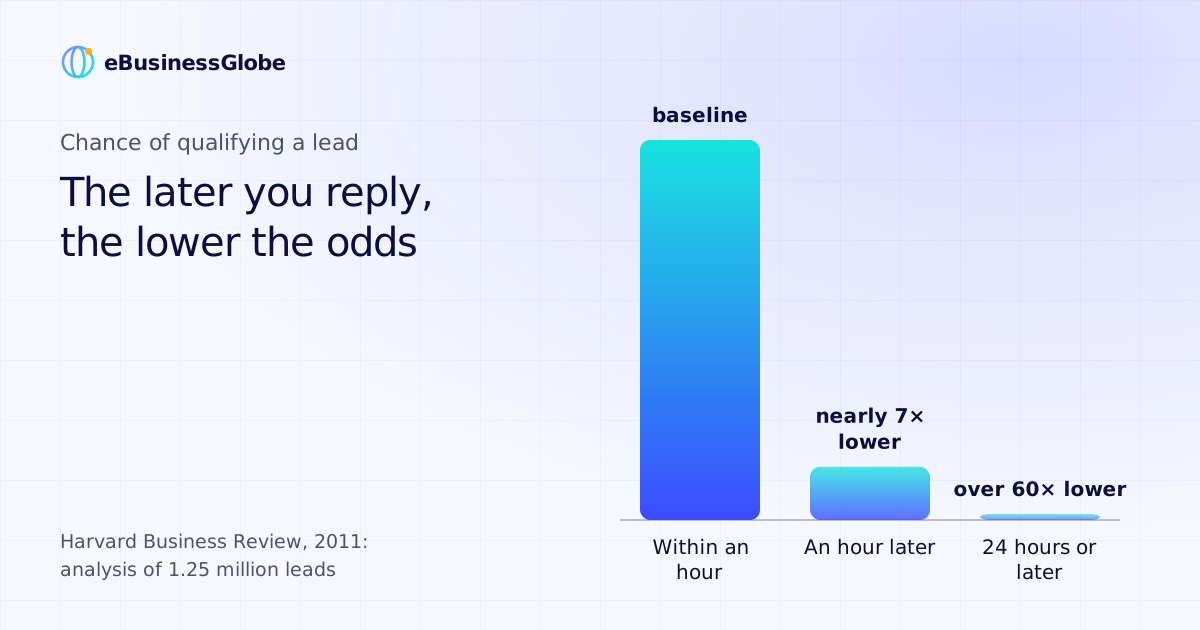
Harvard Business Review, 2011. The authors audited how 2,241 US companies responded to leads submitted through their websites. 37% responded within an hour; 23% never responded at all. The same article analyzed 1.25 million leads: companies that contacted a lead within an hour were nearly 7 times more likely to qualify it than those that called an hour later — and more than 60 times more likely than those that waited 24 hours or longer.
InsideSales and James Oldroyd (MIT). Calling a lead within 5 minutes rather than 30 makes you 100 times more likely to reach them and 21 times more likely to qualify them. An important caveat: this is about qualification — the customer agreeing to continue the conversation — not about closed deals. The data is American and dated, but later studies, including the Russian ones below, point in the same direction.
Russian property developers, 2023. The research studio Startum ran a mystery-shopping test of Russia's 50 largest residential developers. 10 of the 50 never responded to a website inquiry at all. 27 of the 50 responded within 10 minutes. 13 of the 50 set up a meeting with a salesperson.
UIS, 2026. A study of five industries by the company UIS, published in Russia and partly based on mystery shopping. A lead counted as lost if it got no reply within an hour in text channels, or within a business day for calls. Depending on the industry, 16% to 29% of inquiries were lost.
| Industry | Average response time | Share of inquiries lost |
|---|---|---|
| Fitness | 105 seconds | 29% |
| Franchises | 3.5 minutes | 25% |
| Healthcare | 84 seconds | 16% |
Source: UIS, published on Sostav.ru, Aug 10, 2026.
Look at fitness: the average reply comes in under two minutes, yet nearly a third of inquiries are lost. The likely explanation: fast replies to most leads mask a tail of leads that never reach the front of the queue. The number to watch isn't the average — it's the share of leads that never get an answer.
Telfin and OkoCRM, November 2025. In a survey of more than 7,500 business representatives in e-commerce, real estate, and private healthcare, respondents said that when customers have to wait longer than 10 minutes for a reply, roughly half leave without ordering. Patients of private clinics are more patient: mass drop-off starts only after an hour.
The takeaway from all of this is simple. A customer who has just submitted a request is comparing options at that very moment. Whoever replies first, and to the point, gets the conversation. Everyone else's chances are noticeably lower.
Why salespeople don't call back
The usual explanation is "bad salespeople." Sometimes that's true. More often the causes are systemic, and replacing people doesn't remove them.
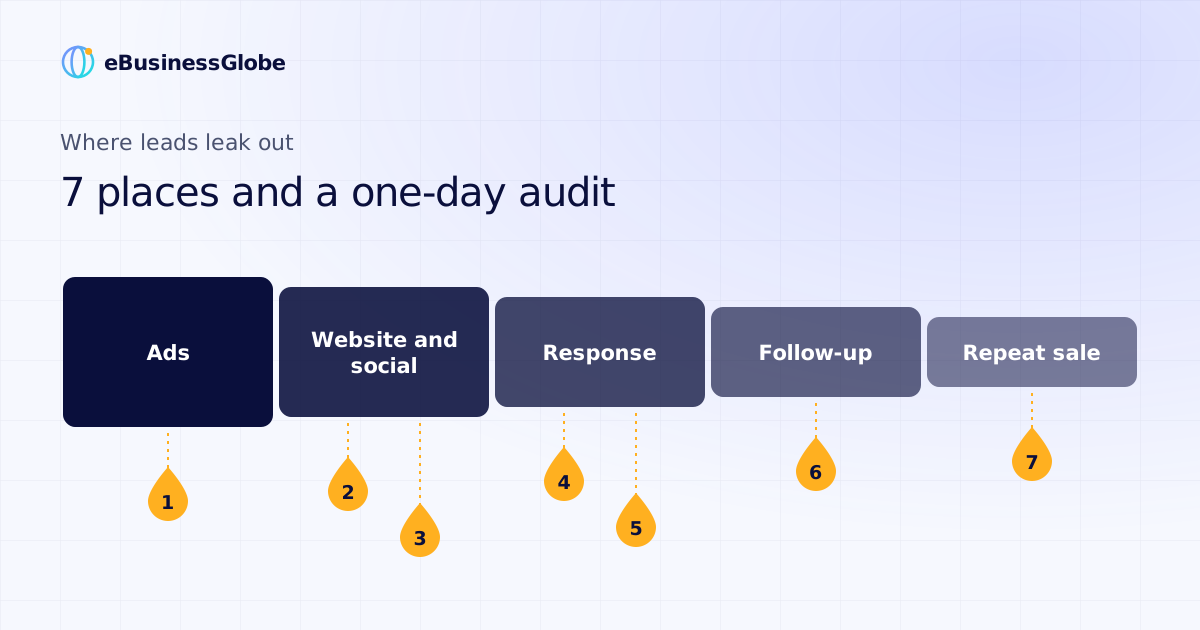
- Leads arrive in different places. The website, WhatsApp, Telegram, Instagram DMs, phone calls. Each channel lives on its own phone or laptop, and there's no shared queue.
- Leads arrive when nobody's there. Evenings, nights, weekends. In the morning, your salesperson starts with the freshest, "warmest" leads, and the overnight ones wait.
- Salespeople decide for themselves who's worth it. A short "how much?" looks unserious, so it gets pushed back. But one line tells you nothing about who's behind it.
- There's no rule for how fast to respond. Without a standard, everyone has their own idea of "quickly."
- The manager can't see the whole picture. Nobody can listen to every call and read every chat, so oversight is spot-checking, and problems only show up when revenue drops.
Every one of these is a process problem, not a motivation problem. So the fix is a process too: a single queue, a response standard, an instant first reply, and complete rather than sampled oversight.
What it costs: the loss formula
You can work out your losses in 15 minutes with data from your CRM, or even from your messaging apps. You need five numbers:
- N — leads per month;
- unanswered share — leads that got no reply at all, or a reply more than 24 hours later;
- late share — leads answered after more than an hour (or after your industry's standard);
- conversion rate for fast and for late responses — from your CRM; if you don't know them, that's your first warning sign;
- average order value and margin.
Lost sales = N × unanswered share × fast conversion rate + N × late share × (fast conversion rate − late conversion rate).
Lost profit = lost sales × average order value × margin.
A worked example on a hypothetical business
This is not a client case. Every number below is an assumption chosen to demonstrate the formula. Use your own.
A services company receives 500 leads a month. Average order value is $300; margin is 40%.
| Metric | Assumption | Calculation |
|---|---|---|
| Answered within an hour | 50% of leads | 250 leads |
| Answered after an hour | 35% of leads | 175 leads |
| Not answered | 15% of leads (a conservative assumption) | 75 leads |
| Conversion with a fast response | 20% | — |
| Conversion with a late response | 10% (conservative: half the fast rate) | — |
| Lost to no response | 75 × 20% | 15 sales |
| Lost to late response | 175 × (20% − 10%) | 17.5 sales |
| Total lost per month | 15 + 17.5 | 32.5 sales |
| Lost revenue | 32.5 × $300 | $9,750 |
| Lost gross profit | $9,750 × 40% | $3,900 per month |
To check: if all 500 leads got a fast response, a 20% conversion rate would yield 100 sales. Today the business makes 250 × 20% + 175 × 10% = 67.5. The gap is the same 32.5 sales.
Now the honest part. No system recovers every lost sale: some customers wouldn't have bought even with an instant reply. If a fast first response and proper oversight recover even half of the loss, that's about $1,950 in gross profit a month for this hypothetical business. That's the number to compare against the monthly cost of any solution. And it's the reason to start with a pilot and a measurement, not a big project.
What AI in sales actually does
Behind the words "AI sales team" are several specific functions. Each one can be rolled out on its own.
| Task | What AI does | What changes |
|---|---|---|
| 24/7 first response | Replies on WhatsApp, Telegram, Instagram, and your website within seconds, using the company's knowledge base: prices, services, locations, terms | Night and weekend leads don't wait for morning |
| Qualification | Asks 3–5 clarifying questions: what they need, when, the budget, who makes the decision | Your salesperson gets a completed lead card, not a bare "how much?" |
| Booking and CRM | Creates the deal, books a time slot, assigns a task to a salesperson | The lead goes straight into the CRM instead of staying on a salesperson's personal phone |
| Reminders | Reminds the customer about the meeting and the salesperson about overdue tasks | Fewer "forgot to call back" moments |
| Call and chat analysis | Transcribes 100% of conversations and scores them against a checklist: did the salesperson introduce themselves, uncover the need, agree on a next step | The manager sees every salesperson's work, not a sample |
| Reactivating past customers | Segments old customers and drafts personalized messages for approval | Past customers get a reason to come back |
All of this works on one condition: the AI has a knowledge base — current prices, policies, answers to common questions. If there's a mistake in it, the AI will confidently repeat that mistake to every customer. That's why the knowledge base needs an owner: a person responsible for keeping it up to date.
Where you still need a person
AI replies fast and never gets tired, but it carries no accountability. So in a sound setup, its boundaries are written down in advance.
Keep these with a person:
- discounts, custom terms, and anything else that changes the price;
- complex negotiations and large deals;
- complaints and conflicts;
- questions where a mistake is dangerous: medical, legal, financial;
- the final decision on whether to work with a customer.
Handoff rules. The AI hands the conversation to a person if the customer asks for one, if the question goes beyond the knowledge base, or if the topic is on the list above. The handoff includes the full conversation history, so the customer doesn't have to repeat themselves.
Reviewing the AI's answers. At the start, a person reviews the AI's replies daily; mistakes are logged and fixed in the knowledge base. Messages to your customer list go only to people who have agreed to receive them. Common sense requires it, and so does the law — in Russia, the Federal Law on Advertising. Check the rules that apply where you operate.
AI doesn't replace a strong salesperson. It takes the routine off their plate — the first reply, gathering the basics, reminders — so they can spend their time on the conversations where deals are actually decided.
Where to start: a plan for the next month
- Measure the baseline for two weeks. First-response time for each channel, the share of unanswered leads, the share of leads that arrive in the evening and on weekends. Without this starting point, you'll have nothing to prove the effect against later.
- Calculate your losses with the formula above. Use your own data. If you have no way to get conversion rates for fast and late responses, start recording them — that alone is useful.
- Set a response standard. For example: a first reply in messaging apps within 5 minutes, and a call-back on website leads within 15 minutes during business hours.
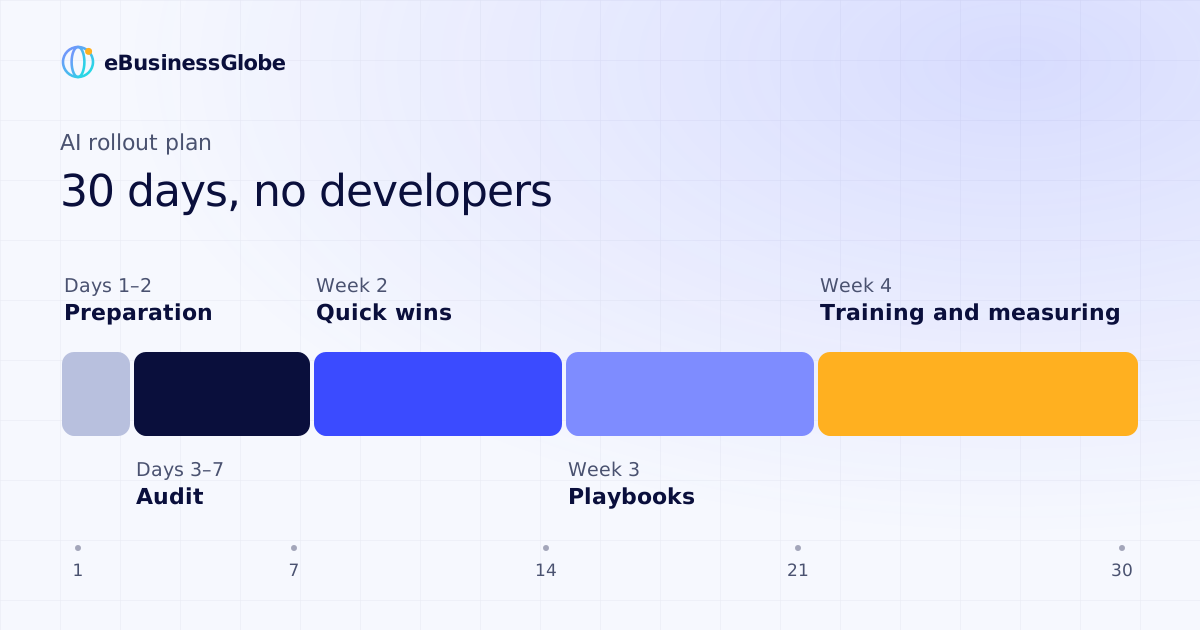
- Run a pilot on one channel. Pick the channel with the most leads or the biggest losses, and give the AI the first response and qualification for 30 days.
- Compare the metrics before and after: first-response time, share of leads handled, conversion to sale, and the share of conversations handed to a person.
If the pilot shows no measurable result, there's nothing to scale — and that's a valuable finding too.
If you want this done for you
At eBusinessGlobe, we build these systems as a product: the AI Sales Department, delivered turnkey. It includes:
- an AI assistant on WhatsApp, Telegram, and Instagram, working 24/7 and qualifying leads;
- appointment booking and lead handoff to your CRM;
- reminders and follow-ups;
- analysis of 100% of calls and chats, with salesperson scoring;
- reactivation of your past customers;
- a "sales pulse" dashboard on the owner's phone.
Timeline: 6–8 weeks — first a pilot on one channel, then the remaining channels, then ongoing support. Implementation costs $5,000–15,000, depending on the number of channels and integrations; support is $500–1,500 a month.
We calculate your losses in money before any work begins. If the 30-day pilot doesn't show a measurable result in response speed, share of leads handled, or conversion, you don't pay for the next stage.
To calculate your losses on your own numbers, message our Telegram bot, @ebusinessglobe_bot, and request a review. The bot will ask a few questions about your company, and if the task is a good fit, we'll set up a 30-minute diagnostic call. If you don't need an AI sales team, we'll tell you so.
Sources
- Oldroyd J., McElheran K., Elkington D., “The Short Life of Online Sales Leads,” Harvard Business Review March 2011
- InsideSales (XANT), Lead Response Management study May 16, 2012
- digitaldeveloper.ru, study of Russian property developers’ contact centers by Startum (in Russian) Sep 15, 2023
- Sostav.ru, UIS study of lead losses in five B2B industries (in Russian) Aug 10, 2026
- Globalmsk.ru, Telfin and OkoCRM survey of 7,500+ businesses (in Russian) Nov 25, 2025
- Russian Federal Law No. 38-FZ “On Advertising”, art. 18 (ConsultantPlus; in Russian)