When sales are slow, the first instinct is to spend more on ads. But often the leads are already there — they just leak out along the way: a missed call, a message nobody answered, a customer nobody called back.
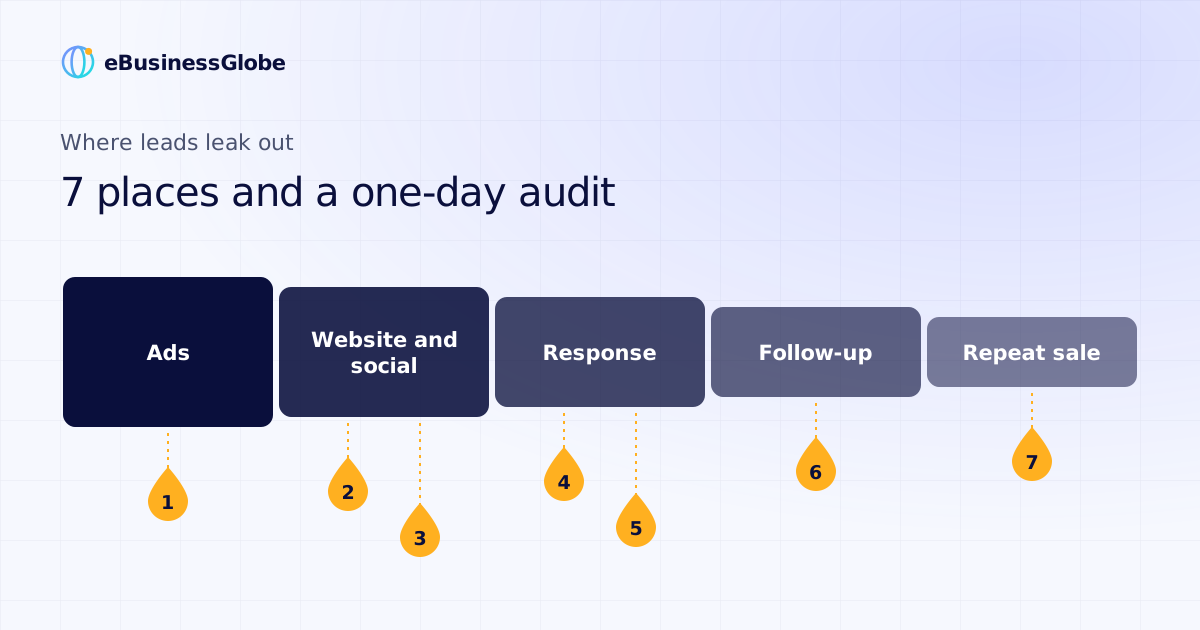
Below are seven of these leaks, in the order a customer meets them. For each one: how to check it yourself in 15 minutes, and how to work out what it costs you. At the end, there's a checklist you can get through in a single working day.
How to use this article
In a small business, the customer's path usually looks like this: ads → website or social media → first response → lead handling → repeat sale. A lead can be lost at every step.
To make the numbers tangible, every calculation below uses one hypothetical example. It's not a client and not a real company — it's a model to plug your own data into:
Hypothetical business: custom furniture. 300 inquiries a month: 180 calls and 120 messages. 10% of inquiries become deals. Average order: ≈$1,460.
Every assumption is labeled. The part that matters in each section is the formula: it works with your numbers.
About the data. We built this for small businesses in the CIS market, and some of the research we cite comes from Russian services companies. The leaks themselves are universal; the benchmarks are a starting point, not a law.
1. You don't know which ads bring in customers
The symptom. Ask "where did our last ten customers come from?" and the answer is "all over" or "word of mouth." Budget gets split by habit, not by results.
The 15-minute check.
- Open your web analytics (Google Analytics, Yandex Metrica, or whatever you use) and see whether conversion goals are set up for leads: form submissions, phone-number clicks, clicks through to messaging apps.
- Check whether the links in your ads and social profiles carry UTM tags.
- Ask your salesperson whether they record a source for every new customer. Pull the last ten deals and see whether it's there.
What it costs. The formula is simple:
Loss = budget of the channel that produces no deals × number of months
Worked example (hypothetical): a budget of ≈$1,830 a month is split evenly across three channels. If one of them produces no sales and you can't see it, that's ≈$610 a month, or ≈$7,300 a year.
What to do. Set up conversion goals, put UTM tags on every link, and make "source" a required field in your CRM — or at least in a spreadsheet. A month later, you'll have the data to decide.
2. Your website loses visitors before they even see it
The symptom. Ads drive clicks, but the site produces few leads. Visitors leave within seconds.
Most inquiries now come from phones. In a services-market study by Callibri, a Russian call-tracking provider, more than 65% of inquiries came from mobile devices. And back in 2016, Google found that 53% of mobile site visits are abandoned if a page takes longer than three seconds to load.
The 15-minute check.
- Turn off Wi-Fi and open your site on your phone over mobile data. Time how many seconds it takes until you can read the first screen.
- Run your homepage through Google's PageSpeed Insights and look at the mobile score.
- Submit a lead through your own form. Did it arrive? To whom, and how many minutes later?
That last check matters more than it looks: a broken form loses every lead sent through it, and nobody ever finds out.
What it costs.
Loss = mobile visits × share lost to slow loading × site conversion rate to lead × lead-to-deal rate × average order
Worked example (hypothetical): 2,000 visits a month, 65% of them mobile. Assume slow loading drives away an extra 20% of mobile visitors, and the site turns 2% of visits into leads. That's 260 lost visitors, about 5 leads, and 0.5 of a deal — ≈$760 in revenue a month.
What to do. Compress images, remove heavy widgets, check your hosting. Test the form today, and have every lead copied to the responsible person in a messaging app.
3. Your social profile doesn't make it clear how to reach you
The symptom. You have views and followers, but few messages. Comments ask "how much?" and "where are you?"
The 15-minute check.
- Open your profile on a phone, from someone else's account. How many seconds until it's clear what you sell, where you are, and how to get in touch?
- Tap every link and button in your profile. Do they all work?
- Scroll through the last month of comments: does every question have an answer?
What it costs.
Loss = profile visits × missed conversion to message × lead-to-deal rate × average order
Worked example (hypothetical): 1,500 profile visits a month. If a clear bio and a working contact button lift the message rate from 1% to 1.5% (assumption), that's 7–8 more inquiries and about 0.75 of a deal — ≈$1,100 in revenue a month.
What to do. Your bio says what you do, for whom, and where. One primary contact button. Prices, or a "from…" price, in the open. Every question in the comments answered within a business day.
4. Calls and messages go unanswered
The symptom. Your salesperson is "always available," but the phone log shows missed calls — especially in the evening, at lunchtime, and on weekends.
This isn't rare. Callibri analyzed 712,000 inquiries to services companies between June 2024 and June 2025: 16.8% of calls went unanswered — roughly one in six. In live chats, by the authors' estimate, one conversation in three gets no reply.
The 15-minute check.
- Export a report of missed calls for the month from your phone system. How many got a callback, and how fast?
- Call your own company at 7:30 p.m. on a weekday and at lunchtime on a Saturday.
- Message every messaging app and social account listed on your website, and time the reply.
What it costs.
Loss = inquiries × share missed × share who never call back × lead-to-deal rate × average order
Worked example (hypothetical): 180 calls × 16.8% = 30 missed calls a month. Assume half of those customers don't try again and go to a competitor (assumption). That's 15 inquiries and 1.5 deals — ≈$2,190 in revenue a month, or more than $26,000 a year.
What to do. Automatic callbacks on missed calls, an on-call rota for evenings and weekends, one shared inbox for every messaging channel. At night and on weekends, an AI assistant can cover the first line: reply, clarify what the customer needs, and hand the lead to a salesperson in the morning.
5. You reply, but too late
The symptom. Leads are handled "during the day." On the second contact, customers say they've already gone with someone else.
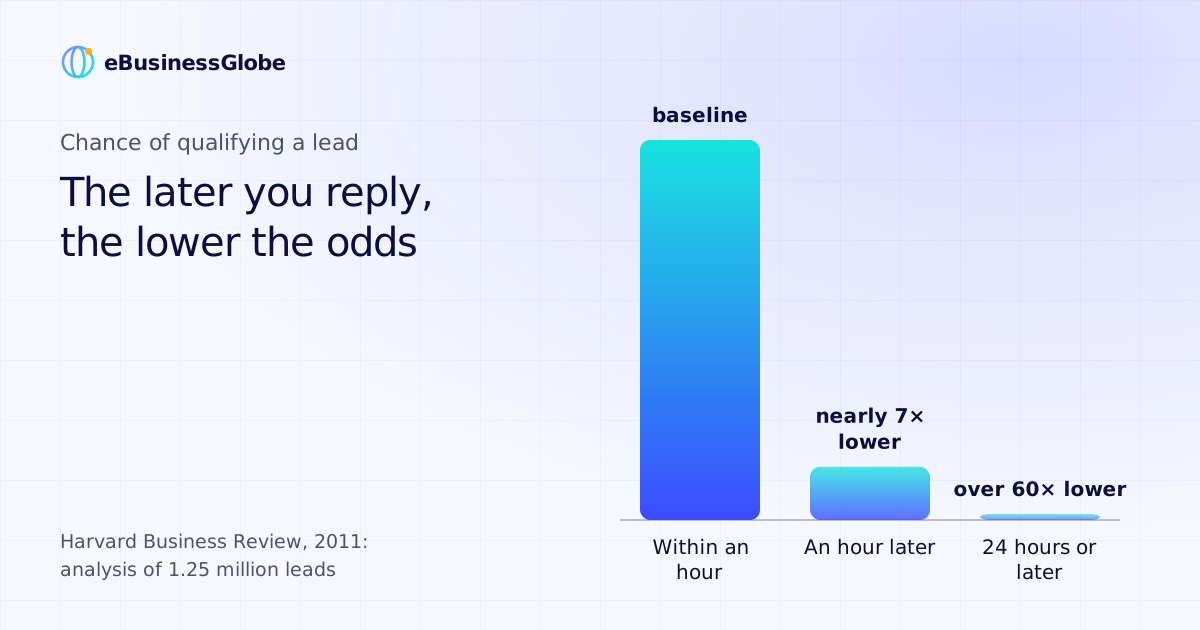
Picture a customer who needs a custom kitchen: they message several companies at once. All else being equal, the one that replies first, with a sensible question, stands a better chance of winning the order. Callibri's benchmark for businesses: answer calls within 20 seconds, and send the first chat reply within a minute.
The 15-minute check. Submit a test lead through your website form and message your company from an unfamiliar number. Time how long the first reply takes, and whether it contains a real question rather than "Hello, how can I help you?"
What it costs.
Loss = slow-response leads × share lost to competitors × lead-to-deal rate × average order
Worked example (hypothetical): of 120 messages a month, 30 get a reply three hours later or more. If a third of those customers close with a competitor first (assumption), that's 10 inquiries and 1 deal — ≈$1,460 in revenue a month.
What to do. Set a first-response standard measured in minutes, not hours. Use first-message templates that include a clarifying question. Send new-lead notifications to the responsible person's phone.
6. The lead came in, but never became a deal
The symptom. The customer said "I'll think about it," and nobody ever followed up. Leads live in salespeople's personal chats and disappear when someone leaves.
The 15-minute check. Take 20 leads from last month and answer one question for each: how did it end? If the answer for some of them is "I don't know," you've found your leak.
What it costs.
Loss = unfinished leads × share you could win back × average order
Worked example (hypothetical): of 300 inquiries, 60 got stuck at "I'll think about it" (assumption). If two or three follow-ups win back just 5% of them (assumption), that's 3 deals and ≈$4,380 in revenue a month.
What to do. Every lead goes into a CRM, or at least one shared spreadsheet, with a status and a next-step date. Follow-up reminders at 1, 3, and 7 days. A weekly review of every stalled lead.
7. Nobody works with existing customers
The symptom. You have a customer list, but the last message to it went out a year ago — or never. Repeat purchases happen on their own.
A new customer usually costs more than an existing one. Harvard Business Review, citing research by Frederick Reichheld of Bain & Company, reports estimates that acquiring a new customer costs 5 to 25 times more than retaining an existing one, and that a 5% increase in retention lifts profits by 25% to 95%. These are estimates from specific studies, not a law for every business, but the order of magnitude is worth keeping in mind.
The 15-minute check.
- Work out what share of last year's sales came from repeat customers.
- Find the date of your last email or message to your customer list.
- Check whether you ask for referrals and reviews after a sale.
What it costs.
Loss = customers on file × missed share of repeat or referral purchases × average repeat order
Worked example (hypothetical): 1,000 customers on file. If regular contact — useful messages, service, a referral request — produces 2% repeat or referral purchases a year (assumption) at an average of ≈$730, that's ≈$14,600 a year, or ≈$1,220 a month.
What to do. Segment your list, define reasons to get in touch (service, season, a new offering), and set up a simple regular newsletter. Make the referral request a standard step after every deal.
What the hypothetical example adds up to
| Leak | Monthly revenue lost, hypothetical example |
|---|---|
| 1. Ads without source tracking | ≈$610 of budget wasted |
| 2. Slow website | ≈$760 |
| 3. Unclear social profile | ≈$1,100 |
| 4. Missed calls | ≈$2,190 |
| 5. Slow replies | ≈$1,460 |
| 6. Unfinished leads | ≈$4,380 |
| 7. No work with existing customers | ≈$1,220 |
Don't simply add these up: the losses overlap, and one lead can't be lost twice. But the scale is clear. Even if your reality is a third of this, you're looking at a sum comparable to the salaries of several employees — and almost all of it is fixed by putting things in order, not by buying more ads.
Checklist: find the leaks in one day
Save it and work through it. Each block takes about 15 minutes, plus time for exports.
Ads and tracking
Website
Social media
Calls and messages
Response speed
Lead handling
Repeat sales
Every unchecked box is a candidate leak. Plug your numbers into the formula from the matching section, and you'll see where to start.
If you'd rather calculate than guess
The checklist catches the obvious. The rest only shows up in the data: call recordings, chat logs, the CRM, ad reports. For that, we at eBusinessGlobe run an AI Business Scan — a paid audit that takes 7–10 days.
What's included:
- interviews with the owner and the team;
- a review of sales, marketing, and operations;
- a map of losses in money — the same formulas, run on your real data;
- a 6–12-month implementation plan: what to fix, in what order, what it costs, and when it pays back.
The price is $800 to $2,000, depending on the size of the company. If you decide within 30 days of the scan to implement the changes with us, its cost is credited toward the implementation. We don't promise to multiply your revenue: every number in the report comes with an explanation of where it came from.
You can start with a free 30-minute diagnostic call. Message our Telegram bot, @ebusinessglobe_bot: it will ask a few questions about your business and book the call. If you don't need the scan, we'll tell you so.